


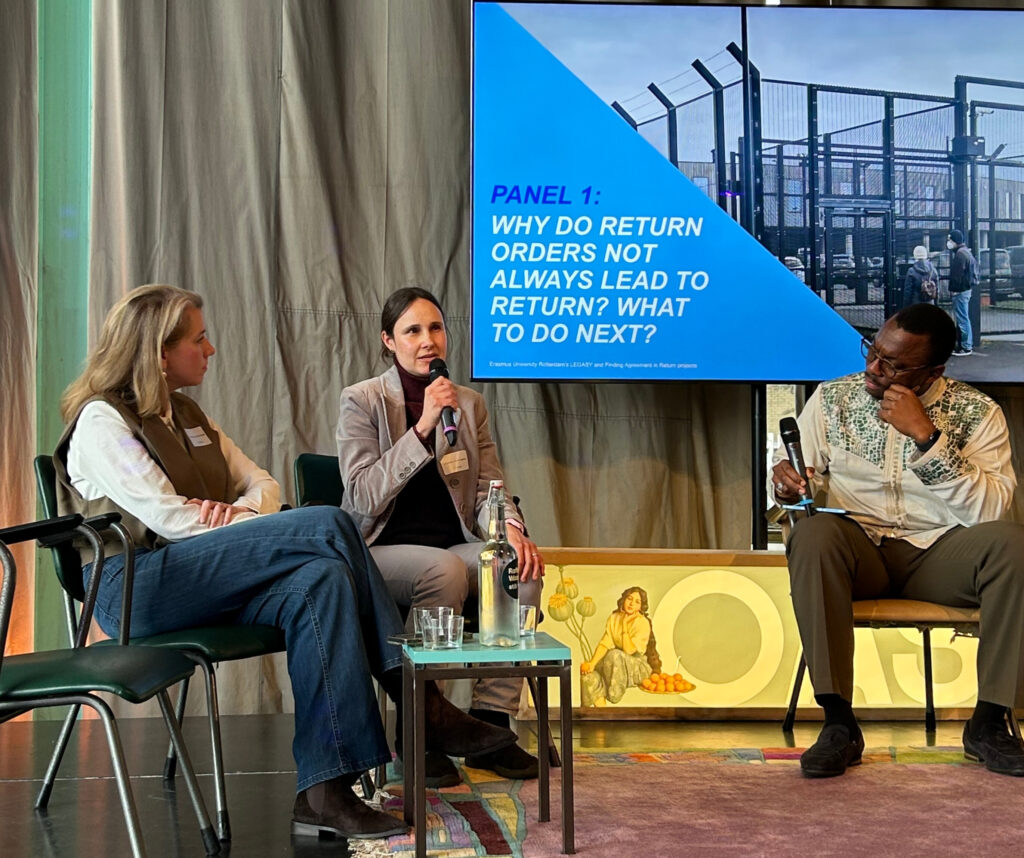
by Jovana Ostojic – No Way Home? An event organised by Erasmus University Rotterdam on European asylum and return policies on Friday, March 13th, 2026 in Rotterdam.
When politicians talk about migration enforcement, they often present a choice: you can be tough, or you can be kind. Protecting the rights of migrants, in this view, makes it harder to remove them. Harsh conditions make people more likely to leave.
The evidence says this is wrong. In several important ways, treating people fairly actually makes return policy work better — not worse.
Two separate lines of research, and the experience of practitioners on the ground, all point in the same direction.
What happens when enforcement becomes too harsh
Rian Ederveen has worked with undocumented migrants in the Netherlands for more than 35 years. She runs a national support centre that connects organizations providing undocumented migrants with shelter, legal advice, healthcare, and assistance with their situation. What she has seen, over and over, is a pattern that politicians rarely acknowledge.
When enforcement becomes very strict — when people fear that any contact with a doctor, a school, or a social worker could lead to arrest and deportation — they disappear. Not because they have been removed. Because they are hiding.
“If you don’t know where people are, how are you going to return them?” — Rian Ederveen, national support centre for undocumented migrants
This is the central problem with a policy based entirely on making life as difficult as possible for undocumented people. It does not make them leave. It makes them invisible. And you cannot have a conversation with someone you cannot find, about returning to a country they left for a reason.
The organisations that do manage to have those conversations — that do sometimes support people in returning — are the ones that have built trust over years. They are trusted because they offer help, not just pressure. Remove the help, and you remove the relationship. And without a relationship, there is no return.
How fairness changes what people do
Ana Maria Torres Chedraui’s research adds an important dimension to this picture. Working within the Legasy project, she and her colleagues surveyed more than 1,200 people living in Dutch asylum reception centres, looking at how asylum seekers experience the process they are in — and what that experience does to them.
The finding that matters most for return policy is this: when people feel that the procedure they are going through is fair — when decisions are explained clearly, when they are treated with respect, when the process feels honest — they are more likely to accept negative decisions as legitimate.
“When asylum seekers feel the procedure is impartial and unprejudiced, their wellbeing is higher. And they are also somewhat more likely to accept a return decision as a legitimate outcome that they should follow.” — Ana Maria Torres Chedraui, asylum seeker perceptions researcher
This is what researchers call a legitimacy effect — the idea that people are more likely to go along with a decision if they believe the process that produced it was fair. It does not mean that people who feel fairly treated will happily agree to leave. But it does mean they are less likely to resist, more likely to cooperate with caseworkers, and more likely to engage with conversations about return.
The policy implication is direct. Investing in good procedures — in training caseworkers, in providing legal support, in explaining decisions clearly — is not just a moral choice. It is an investment in a system that actually functions.
What happens at the bottom of the scale
Researcher Antonella Patteri has spent years studying what deportation looks like in practice — the specific moments and interactions through which removal is carried out. Her findings reveal something troubling: the language of dignity and human rights is sometimes used to justify practices that are anything but dignified.
In one country she studied, research findings addressed how authorities carried out what they called ‘unannounced deportations’ — not telling the person they were being deported until they found themselves at the airport. The justification? Human rights. Telling people in advance, the argument went, might cause them to harm themselves while, indeed, this can be functional to proceed with deportations without deportees’ resistance.
“They are using the language of dignity to justify a practice that is, by any reasonable measure, deeply undignified. People arrive at an airport not knowing they are being sent away. That is not protection. It is deception.” — Antonella Patteri, deportation researcher
This matters because it shows what happens when human rights language becomes a box to tick rather than a principle to follow. Compliance on paper is not the same as treatment with dignity in practice. And when people are treated as though their experience does not matter — deceived, disrespected, processed rather than heard — the practical consequences are clear: more resistance, more legal challenges, more breakdown of cooperation.
Research consistently shows that going below a basic threshold of dignity tends to make return harder, not easier. People become unwilling to engage, psychologically unable to move forward, and legally better placed to challenge the process. The system that was designed to produce departures ends up producing gridlock.
A different way of framing the debate
The argument here is not that rights should be traded off against effectiveness when it is politically convenient. Rights matter on their own terms. But for those who think primarily about whether policy works, the evidence points the same way: systems that treat people fairly tend to function better than systems that do not.
This should change how the debate is framed. Advocates for human rights and advocates for effective migration management are often presented as opponents. They are not. They share an interest in systems that are honest, transparent, and capable of building enough trust to actually achieve their goals.
The research from FAiR and Legasy suggests that the most effective return policy is not the harshest one. It is the one that people — asylum seekers, caseworkers, communities, and states — are willing to believe in.